Rhythm Before the Record: Tracing Jazz Back to the West African Musical Intelligence America Chose to Forget
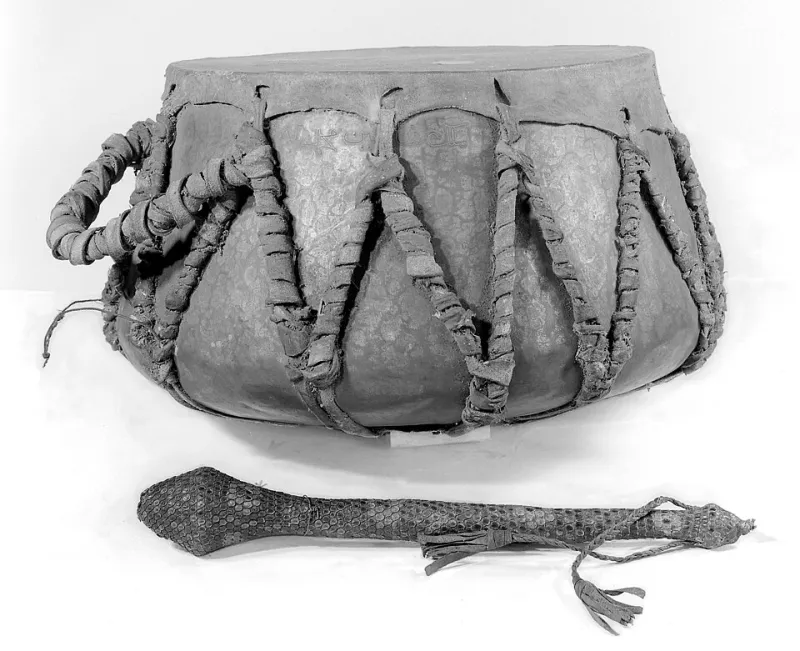
Photo: Unknown, CC BY 4.0, via Wikimedia Commons
When the Library of Congress designated jazz a national treasure in the 1980s, the accompanying rhetoric was characteristically American in its self-congratulation. Jazz was described as a gift the United States gave to the world—a democratic art form born from the unique conditions of New Orleans, shaped by European harmonic theory and the improvisational spirit of a young republic. What that framing omitted was not incidental. It was structural. The musical intelligence at jazz's core—the polyrhythmic layering, the call-and-response architecture, the philosophy of collective improvisation—did not originate in Louisiana. It originated in the river valleys, coastal communities, and sacred ceremonial spaces of West and Central Africa, and it arrived in the Americas through one of history's most catastrophic forced migrations.
Reclaiming that origin is not a matter of cultural grievance. It is a matter of historical accuracy. And it begins, as most honest histories do, with specificity.
The Architecture of West African Musical Thought
To understand what jazz inherited, one must first understand what West African musical traditions actually are—not as background rhythm or primitive precursor, but as sophisticated, philosophically grounded systems of organized sound.
Across the Yoruba, Ewe, Akan, Mandé, and Fon peoples, among others, music was never conceived as a passive listening experience. It was participatory, relational, and structurally complex in ways that European classical theory had no ready vocabulary to describe. The Ewe drumming tradition of present-day Ghana and Togo, for instance, operates on a principle of interlocking rhythmic patterns—what ethnomusicologists now call polyrhythm—in which multiple independent rhythmic lines are played simultaneously, each incomplete on its own but generative in combination. The resulting texture is not cacophony; it is deliberate counterpoint, a sonic democracy in which no single voice dominates.
Call-and-response, known in Yoruba ceremonial contexts as a form of dialogue between the sacred and the communal, structured not only music but the social fabric of performance itself. A lead voice—human or instrumental—poses a musical phrase; the ensemble answers, transforms, or challenges it. This is not merely a compositional technique. It is an epistemological stance: knowledge is not delivered from above but constructed through exchange.
Perhaps most significantly, West African musical traditions privileged improvisation not as deviation from a fixed score but as the demonstration of mastery. The griot, the jeli, the ceremonial drummer—each was expected to respond in real time to the emotional and spiritual conditions of a gathering. Memorization was a floor, not a ceiling.
The Middle Passage and the Survival of Sound
The transatlantic slave trade did not erase these traditions. Enslavers tried. Drum bans were legislated across the American South, most notably in South Carolina's 1740 Negro Act, which explicitly prohibited enslaved people from using drums out of fear—well-founded, as it turned out—that percussion could carry coded communication across distances. What the legislation could not ban was the human voice, the body as instrument, or the internalized rhythmic frameworks that survived in work songs, field hollers, and the ring shout.
The ring shout, practiced by enslaved communities across the coastal South, is perhaps the most direct surviving link between West African ceremonial performance and what would eventually become jazz. Participants moved counterclockwise in a circle, singing, clapping, and stomping in interlocking rhythmic patterns that bore unmistakable structural resemblance to Yoruba and Kongo ritual music. Scholars including Sterling Stuckey and Sylviane Diouf have documented this continuity with considerable rigor, tracing specific rhythmic cells and call-and-response patterns from their African ceremonial contexts through their American transformations.
In New Orleans, where the convergence of French, Spanish, Haitian, and African-descended populations created conditions unlike anywhere else in North America, these traditions were not merely preserved—they were elaborated. Congo Square, the open-air gathering place where enslaved and free Black people assembled on Sundays throughout the late eighteenth and early nineteenth centuries, was one of the only places in the antebellum United States where African musical practice was performed publicly and with relative visibility. Visitors recorded what they heard: complex polyrhythmic drumming, chanting in West African languages, dancing in recognizable African forms. Congo Square was not a curiosity. It was a living laboratory in which African musical intelligence was being sustained and evolved in real time.
How Jazz History Learned to Look Away
The earliest serious attempts to document jazz's origins, written primarily in the 1930s and 1940s, made choices that would distort the field for decades. Writers including Henry Osgood and Paul Whiteman—the latter of whom crowned himself the "King of Jazz" to considerable commercial success—framed jazz's development as a process of European refinement applied to raw African energy. The language was not subtle. African influence was acknowledged as rhythm, as vitality, as something pre-rational that required harmonic structure to become art. European influence was credited with melody, composition, and sophistication.
This framing was not merely condescending. It was empirically wrong. The improvisational frameworks that define jazz at its most complex—the ability to construct coherent, emotionally resonant musical statements in real time within a collectively negotiated structure—are not European inheritances. European classical music, with its written scores and its conductor-centered hierarchy, operated on almost precisely opposite principles. The jazz musician's relationship to a standard, the way a Miles Davis or a John Coltrane could inhabit and simultaneously deconstruct a melody, is philosophically continuous with the West African ceremonial musician's relationship to tradition: reverence and transformation held in simultaneous tension.
Even sympathetic early jazz historians frequently located the music's genius in individual European-American innovators or in the unique conditions of New Orleans without adequately accounting for the specific African musical technologies those innovators had absorbed, often directly, from Black teachers, neighbors, and collaborators who were rarely named in the historical record.
Contemporary Efforts at Restoration
The work of correcting this record is ongoing. Ethnomusicologists including Samuel Floyd Jr., whose foundational text The Power of Black Music (1995) introduced the concept of cultural memory as a mechanism for understanding African survivals in African American music, have provided scholarly frameworks that take African origins seriously as analytical categories rather than sentimental gestures. The Smithsonian's National Museum of African American History and Culture has incorporated this scholarship into its permanent exhibitions, situating jazz explicitly within a diasporic continuum rather than an exclusively American narrative.
At the community level, musicians and educators associated with institutions like the Thelonious Monk Institute of Jazz and New Orleans' own Tipitina's Foundation have developed curricula that trace the African roots of jazz with the same granularity applied to its bebop or cool jazz periods. These efforts matter not only for historical completeness but for living practitioners—young musicians who deserve to understand the full depth of the tradition they are entering.
The stakes of this restoration extend beyond music history. Jazz's misattribution is a case study in how cultural credit is assigned and withheld along racial lines, and how that misattribution becomes naturalized through repetition until it acquires the texture of settled fact. The African musical frameworks that became jazz were not raw material waiting for civilization to arrive. They were civilization—complex, philosophically coherent, and generative enough to produce the most influential musical tradition the modern world has known.
America called it jazz and called it its own. The fuller truth is older, deeper, and considerably more demanding of our attention.