Threads of Knowledge: How African Weavers Encoded Mathematics, Memory, and the Cosmos Into Cloth
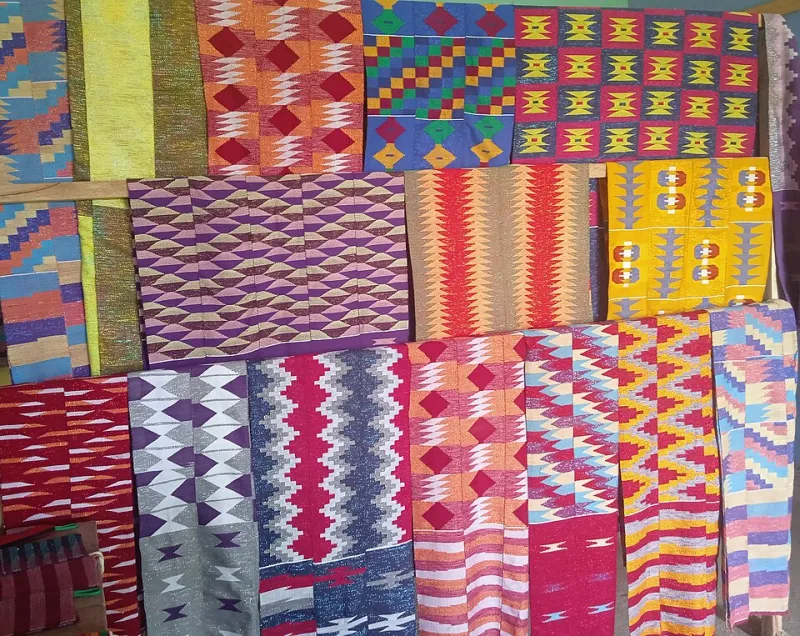
Photo: Warmglow, CC0, via Wikimedia Commons
In American museums, African textiles are most often displayed in cases labeled "decorative arts" or "material culture," positioned alongside pottery and carved figures as evidence of aesthetic achievement. The framing is not hostile, exactly — but it is limiting in ways that matter. It places the cognitive work of African weavers in a separate category from the cognitive work of African philosophers or mathematicians, as though the loom and the mind that operated it were somehow distinct instruments.
The evidence accumulated over the past several decades of ethnomathematical and archaeoastronomical research suggests a very different picture. Across a wide range of African weaving traditions — Asante Kente cloth, the strip-woven textiles of the Sahel, Kuba cut-pile fabric from central Africa, and the indigo-resist traditions of West Africa — researchers have documented systematic encoding of mathematical sequences, astronomical observations, genealogical records, and philosophical frameworks. These are not metaphorical readings. They are structural features of the textiles themselves, recoverable through formal analysis.
The implications are significant. If textiles functioned as data storage systems — capable of preserving and transmitting complex knowledge across generations without a literate scribal class — then the standard Western narrative about the relationship between writing and civilization requires revision. Africa had knowledge technologies that the West never developed. That is a different kind of story than the one most Americans have been taught.
The Arithmetic of the Loom
Begin with the mathematics, because it is the most formally verifiable dimension of this tradition. Ron Eglash, an American mathematician and cultural theorist whose 1999 study African Fractals remains the foundational text in this area, demonstrated that numerous African textile traditions employ recursive geometric structures — patterns that repeat at multiple scales in self-similar configurations — that correspond formally to fractal geometry.
Fractal structures require a generative algorithm: a rule that, when applied repeatedly, produces the observed pattern. The weavers who produced these textiles were not randomly arranging color blocks. They were executing mathematical procedures, translating abstract rules into physical form through the mechanics of the loom. Eglash documented this across Kente cloth patterns from Ghana, Bamana mud cloth from Mali, and several other traditions, demonstrating that the underlying algorithms were consistent, teachable, and transmitted across generations as craft knowledge.
This is not a trivial point. The capacity to conceive, encode, and reproduce fractal algorithms is a sophisticated mathematical achievement. It predates the formal Western mathematical description of fractals by centuries. That this knowledge was carried in the hands and minds of weavers rather than in the pages of academic treatises does not diminish it. It should, instead, prompt a reconsideration of where we look for mathematical history.
Kente cloth offers particularly rich examples. The strip-weaving technique used by Asante weavers requires the simultaneous management of multiple color sequences across a narrow band, with the strips later assembled into a larger composition. The color relationships between strips follow rules — symmetry operations, rotational transformations, complementary pairings — that produce the complex geometric effects visible in finished cloth. Master weavers carry these rules in memory, passing them to apprentices through demonstration and practice rather than written notation. The knowledge is no less precise for being embodied rather than inscribed.
Astronomical Calendars in Indigo and Cotton
The relationship between African textiles and astronomical knowledge is less thoroughly studied than the mathematical dimensions, but the evidence is compelling. Several West African weaving traditions encode calendrical and astronomical information in ways that served practical functions in agricultural and ritual life.
Among the Dogon people of present-day Mali, whose astronomical knowledge has attracted considerable scholarly attention since Marcel Griaule's controversial mid-twentieth century fieldwork, textile patterns associated with ritual contexts incorporate symbols corresponding to celestial observations embedded in Dogon cosmological teaching. The debate over the extent and origins of Dogon astronomical knowledge remains active among scholars — but what is not disputed is that textile production was integrated into systems of knowledge transmission that included celestial observation.
More concretely, the weaving calendars documented among several Sahelian societies structured production cycles around astronomical markers. The timing of specific dye processes, the commencement of new pattern sequences, and the ritual presentation of finished cloth were coordinated with lunar and solar cycles in ways that required sustained astronomical observation and record-keeping. The textile itself became a mnemonic device for that calendar — a physical record of when certain knowledge was produced and what celestial conditions governed its production.
The indigo-dyeing traditions of West Africa add another layer. The fermentation process required to produce indigo dye is temperature-sensitive and time-dependent in ways that demand precise environmental knowledge. Dye masters in traditions from Yorubaland to the Gambia River valley maintained what were effectively empirical records of seasonal temperature variation, rainfall patterns, and fermentation cycles — knowledge that was encoded in the sequencing and timing of production rather than in written form, but that was no less systematic for that.
Cloth as Archive: Genealogy and Historical Record
Beyond mathematics and astronomy, African textiles served as historical archives in a more direct sense. Among the Kuba kingdom of present-day Democratic Republic of Congo, the production of raffia cut-pile cloth was closely tied to royal genealogy. Specific patterns were associated with specific rulers, and the sequence of pattern innovations constituted a kind of dynastic record. Kuba oral tradition holds that each king introduced a new pattern during his reign — a claim that historians have been able to partially verify by cross-referencing pattern sequences with independent genealogical sources.
This is archival function in a precise sense. The textiles preserved information about the sequence of reigns, the aesthetic priorities of individual rulers, and the social organization of production that supported the royal court. A trained Kuba specialist reading a sequence of cloth patterns was, in effect, reading a dynastic history — one that required specialized knowledge to decode but that was no less legible for being encoded in fiber rather than ink.
The Asante tradition of Kente cloth naming follows a similar logic. Individual patterns carry names that reference historical events, philosophical concepts, or proverbial wisdom. The pattern known as Sika Futuro — "gold dust" — encodes a commentary on the relationship between wealth and social responsibility that is part of Asante political philosophy. Wearing it is not merely aesthetic self-expression. It is a statement of philosophical alignment, legible to others who share the knowledge system.
Rethinking the Technology of Knowledge
For American readers, the significance of this history extends beyond the academic. The United States has inherited a framework in which literacy — specifically alphabetic writing — is treated as the threshold technology of complex thought. Societies that lacked writing are presumed, in this framework, to have lacked the capacity for the kinds of systematic knowledge that writing makes possible: mathematics, history, astronomy, philosophy.
African textile traditions challenge this framework at its foundation. They demonstrate that complex knowledge — formally sophisticated, systematically organized, reliably transmitted across generations — can be encoded in physical media other than script. The loom is a knowledge technology. The dye vat is a laboratory. The master weaver is, among other things, a mathematician, an astronomer, and a historian.
Recognizing this does not require romanticizing African textile traditions or treating them as equivalent to written scholarship in every respect. It requires only that we extend to them the same analytic seriousness we bring to written records — and that we ask, honestly, what we have been missing by failing to do so for this long. The answers woven into the cloth have always been there. The question is whether we are finally prepared to read them.