Keepers of the Living Archive: Why the Griot Tradition Represents One of History's Most Sophisticated Knowledge Technologies
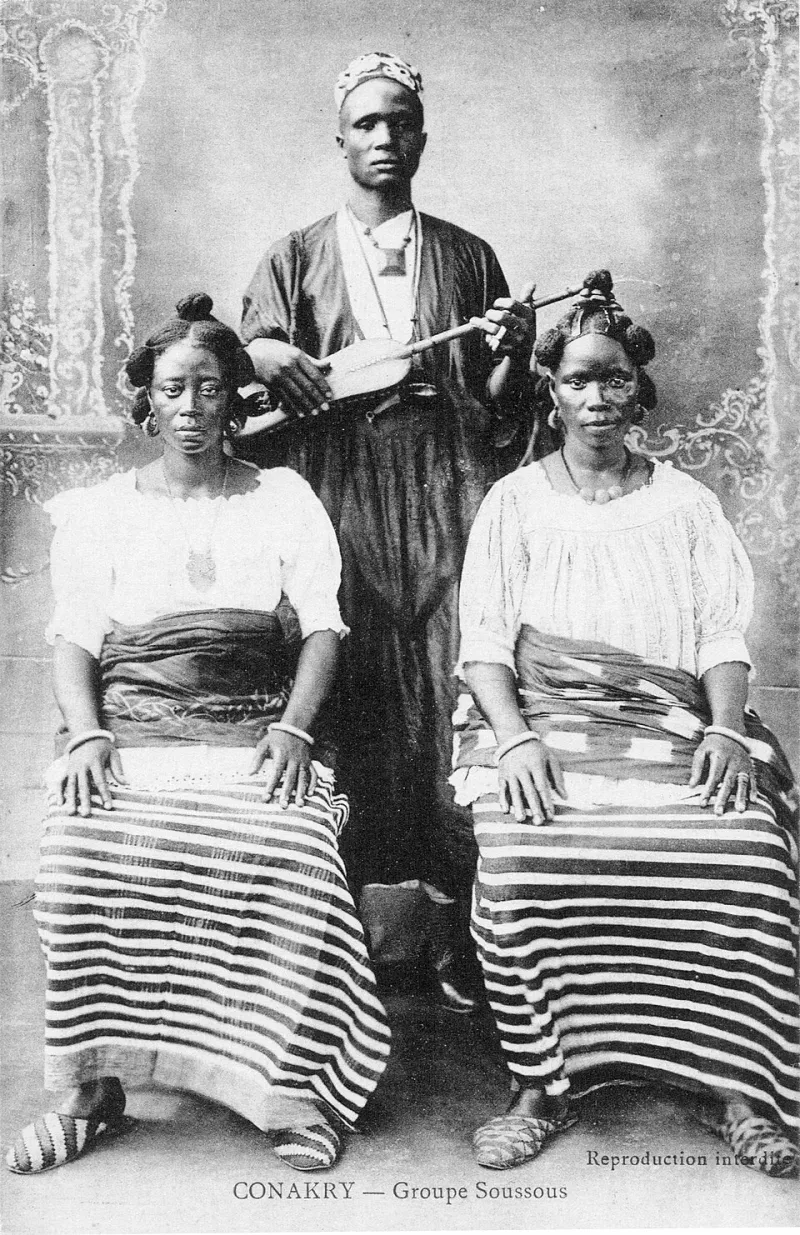
Photo: unknown photographer, c. 1910, Public domain, via Wikimedia Commons
There is a phrase attributed to the Malian oral historian Amadou Hampâté Bâ that has circulated widely enough to become something of a cliché, though its meaning has not been fully absorbed: "In Africa, when an old man dies, it is a library that burns." The metaphor is precise. What Bâ was describing was not sentiment but architecture—the recognition that certain communities had constructed, over many centuries, a form of knowledge storage as deliberate, as structured, and as durable as any written archive. The practitioners of that architecture were the griots, and their marginalization by Western scholarship represents one of the more consequential intellectual errors of the modern era.
Correcting that error is not merely an academic exercise. It is a prerequisite for understanding African history on its own terms—and, increasingly, for understanding where human knowledge systems may be heading.
What the Word "Griot" Actually Means
The term itself is of uncertain etymology, likely derived from a Portuguese or French colonial rendering of a West African word, and its use as a catch-all label obscures significant internal distinctions. Across the Mande, Wolof, Fulani, and related cultural spheres of West Africa, the practitioners of oral knowledge transmission carry distinct titles—jeli, gewel, gawlo, among others—and occupy differentiated social roles with their own internal hierarchies, ethical codes, and areas of specialization.
What these practitioners share is a professional identity organized around the preservation and transmission of knowledge. Griots serve as historians, genealogists, musicians, diplomats, and philosophers. In many societies, they function as the institutional memory of ruling lineages, responsible for reciting genealogies that extend back dozens of generations and for contextualizing present events within long historical arcs. They are, in the most literal sense, living databases—but that description, while useful, undersells the interpretive and analytical dimensions of their work.
A griot is not simply a recording device. The tradition demands active curation: the ability to assess what is relevant, to draw connections across time, to read an audience and calibrate a performance to its needs. This combination of storage and analysis is precisely what makes the tradition so difficult to categorize within Western epistemological frameworks—and precisely what made it so easy for colonial-era anthropologists to misread.
The Epistemology of Dismissal
The intellectual history of how Western scholars approached African oral traditions is not a flattering one. From the nineteenth century through much of the twentieth, the dominant framework was evolutionary: written cultures were presumed to represent a higher stage of cognitive development than oral ones, and the absence of writing was routinely interpreted as evidence of intellectual limitation rather than as a different set of technological choices made in response to different circumstances.
This framework was not neutral. It served the ideological requirements of colonialism, which needed to construct African societies as intellectually underdeveloped in order to justify political domination. The griots, under this reading, became entertainers or praise-singers—their knowledge reduced to flattery and mythology, their precision dismissed as coincidence.
The philosopher V.Y. Mudimbe, in his foundational 1988 work The Invention of Africa, traced the genealogy of this dismissal with surgical precision, demonstrating how Western categories of knowledge systematically distorted the study of African intellectual life. What Mudimbe identified as the "colonial library"—the accumulated body of European scholarship on Africa—was less a record of what African societies were than a record of what European scholars needed them to be.
The griots did not fit that need. So they were flattened.
The Architecture of Oral Precision
What the dismissal missed was the sophistication of the mnemonic and structural technologies that oral knowledge systems employ. Griots do not simply memorize text in the way a student might memorize a passage for an exam. The tradition employs a layered system of devices—rhythmic patterns, melodic contours, formulaic phrases, call-and-response structures, and narrative scaffolding—that work together to encode information in multiple redundant channels simultaneously.
Researchers in cognitive science and linguistics have increasingly recognized that these structures are not primitive substitutes for writing but rather highly optimized solutions to the problem of long-term, high-fidelity information storage in non-literate contexts. The work of scholars like Jan Vansina, whose 1965 study Oral Tradition as History was one of the first serious academic defenses of oral sources, helped establish that griot accounts could be cross-referenced against archaeological and documentary evidence with a degree of accuracy that challenged the assumption of inevitable distortion over time.
More recent research has gone further. Studies of the Sundiata epic—the foundational oral history of the Mali Empire, preserved by Mande griots for roughly eight centuries—have found that its geographic, genealogical, and political details align with independent sources at a rate that would be considered impressive for any written chronicle of comparable age. The tradition, it turns out, was doing exactly what it claimed to be doing.
Genealogy as a Form of Political Philosophy
One dimension of the griot tradition that remains underappreciated in American contexts is the political function of genealogical knowledge. In many West African societies, the griot's ability to recite a ruler's lineage was not ceremonial theater. It was a form of constitutional authority—a public record that established legitimacy, adjudicated disputes over succession, and held power accountable to historical precedent.
This is a fundamentally different relationship between knowledge and power than the one most Americans are accustomed to. In the griot tradition, the keeper of historical memory occupies a position of genuine, institutionalized authority. The griot can, and historically did, correct rulers who misrepresented their own lineages or violated the norms their ancestors had established. Knowledge, in this framework, is not merely descriptive but normative—a resource that communities deploy to regulate the exercise of power.
Understanding this dimension of the tradition reframes the griots not as peripheral cultural figures but as central constitutional actors in the societies that sustained them.
The Digital Age and the Return of Orality
There is a striking irony in the contemporary relevance of the griot tradition. The digital age, which was initially celebrated as the apotheosis of written culture, has in practice produced a dramatic resurgence of oral and performative communication. Podcasts, video essays, and social media have made spoken, embodied, contextualized knowledge transmission central to how millions of Americans receive and process information.
Scholars of digital humanities have begun drawing explicit comparisons between the structural features of oral knowledge systems and the networked, distributed, redundant architecture of the internet. Both systems prioritize accessibility over fixity, transmission over storage, and community over individual authorship. The griot's knowledge lives in relationship—between performer and audience, between the living and the ancestral—in ways that anticipate, rather than contradict, the relational logic of networked communication.
This is not to romanticize either tradition or to suggest that the griot and the podcast are equivalent. It is to suggest that the Western dismissal of oral knowledge systems as technologically backward was not only historically wrong but analytically impoverished—and that recovering a more accurate understanding of the griot tradition has something to teach us about where knowledge itself is going.
The archive, it turns out, was never only on the page. It was always also in the voice, the memory, and the relationship between the one who speaks and the community that listens. The griots knew this. It has taken the rest of the world some time to catch up.